10+ years of helping amazon sellers ! GET BACK ON TRACK ! REACTIVATE YOUR ACCOUNT NOW

Amazon Account Deactivated After Video Verification – Section 3 Guide
Amazon seller account deactivated after video verification? Learn why Section 3 happens and the correct recovery strategy from reinstatement experts.
MD MUSTAFEEZ ALAM
12/18/20253 min read
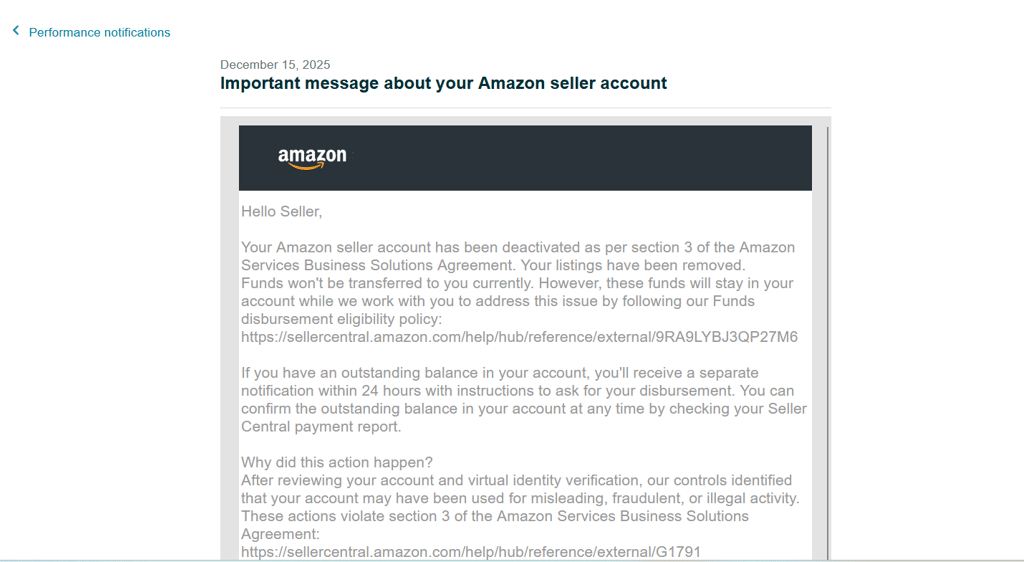

Amazon Seller Account Deactivated After Video Verification? (Section 3) – Complete Recovery Guide by an Expert
Amazon seller account deactivation under Section 3 of the Amazon Business Solutions Agreement is one of the most serious and confusing enforcement actions a seller can face — especially when it happens after completing video identity verification.
Many sellers contact us saying:
“My video verification went fine, but Amazon still deactivated my account.”
“I submitted genuine documents, why did Amazon reject me?”
“This is a new account with no sales — how can it be fraudulent?”
After helping hundreds of sellers globally with Amazon suspensions, deactivations, and identity reviews, this guide explains exactly why this happens, what Amazon is really checking, and how to respond correctly to maximize your chances of reinstatement.
What Is Amazon Section 3 Deactivation?
Amazon Section 3 deactivation means Amazon believes your account poses a risk to customers or the marketplace, even if:
You haven’t sold anything yet
You passed document checks
You completed video verification
You did nothing intentionally wrong
Section 3 is risk‑based, not punishment‑based.
Amazon does not need to prove fraud — only suspected risk.
Why Amazon Deactivates Accounts Even After Video Verification
This is the biggest misunderstanding sellers have.
❌ Video verification is NOT approval
✅ Video verification is only a data collection step
After the call, Amazon runs backend system checks, including:
Account ownership consistency
Location and device intelligence
Cross‑border control risk
Financial alignment (banking & business)
Behavioral and language indicators
Historical risk patterns
If any mismatch remains, Amazon can still deactivate the account.
The Most Common Real Reasons for Post‑Verification Deactivation
Based on real reinstatement cases, here are the top triggers:
1. Owner vs Operator Doubt
Amazon must be confident that:
The person on camera
The person on documents
The person controlling the account
…are the same individual.
If Amazon suspects proxy operation, the account is deactivated.
2. Cross‑Border Business Risk (Very Common)
Example:
Passport from one country
Business registered in another country
Banking in a third country
This is legal, but high‑risk, especially for new accounts with no selling history.
Amazon asks:
“Is this a genuine business or a nominee setup?”
3. Assisted Video Interviews
If someone:
Guides answers
Translates unofficially
Speaks from behind the camera
Amazon may conclude:
“The account owner lacks independent operational control.”
This alone can be enough to fail Section 3.
4. Banking & Financial Mismatch
Amazon expects logical alignment between:
Business country
Bank account
Seller account setup
Personal foreign bank statements used with a foreign‑owned US LLC are a major red flag unless perfectly explained.
5. New Account + No History
New companies with:
Fresh EIN
No listings
No sales
Immediate verification issues
Are automatically treated as higher risk.
Why Amazon Sends Structured “Ownership & Control” Forms
When Amazon asks questions like:
Who registered the account?
Who operates it?
From where is it operated?
Proof of fulfillment
Supply chain documents
They are not asking randomly.
They are asking:
“Prove this is a real, independently controlled business.”
This is usually the last meaningful chance before permanent closure.
The Biggest Mistake Sellers Make
Uploading too many documents.
More documents = more chances for:
Address mismatches
Formatting differences
Conflicting information
Amazon prefers clarity over volume.
The Correct Way to Respond (Expert Strategy)
From experience, the safest approach is:
✅ Clear written answers (ownership & control)
✅ Minimal supporting declarations
❌ No unnecessary re‑uploads
❌ No emotional appeals
❌ No accusations against Amazon
Two simple signed declarations often work better than ten official documents.
Example: Acceptable Declarations
Declaration of No Order Fulfillment (for new accounts)
Supply Chain Declaration (if no products were listed)
These show:
Honesty
Transparency
Accountability
Which is exactly what Amazon wants in Section 3 cases.
Should You Use Letterhead, Stamp, or Notary?
No.
Amazon prefers:
Plain paper
Hand‑signed declarations
Simple language
Over‑legalizing documents can actually increase suspicion.
Can Section 3 Accounts Be Reinstated?
Honest answer:
Yes, sometimes
Not guaranteed
Depends on risk confidence, not document authenticity
If reinstatement fails, sellers should then focus on:
Funds eligibility
Clean exit strategy
Avoiding permanent ecosystem bans
Why Professional Guidance Matters in Section 3 Cases
Section 3 appeals are not standard POAs.
They require:
Risk interpretation
Strategic wording
Understanding how Amazon systems think
Knowing when not to submit
This is where most sellers fail — not because they are wrong, but because they respond incorrectly.
About SellerReinstatement.com
At SellerReinstatement.com, we specialize only in:
Amazon account suspensions
Section 3 deactivations
Video verification failures
Identity & linked account cases
We do not sell software.
We do not offer generic templates.
We work case‑by‑case, globally.
Frequently Asked Questions (FAQs)
Q1. Can Amazon permanently ban me under Section 3?
Yes, if risk concerns are not resolved. That’s why the first response is critical.
Q2. Is foreign ownership allowed on Amazon?
Yes, but it must be clearly structured and independently controlled.
Q3. Should I create a new account if this fails?
Absolutely not. This can result in lifetime bans and fund forfeiture.
Q4. Does passing video verification guarantee approval?
No. Many rejections happen after video verification.
Q5. Can funds be released even if the account stays deactivated?
In many cases, yes — if handled correctly.
Final Advice from an Expert
Amazon Section 3 deactivations are not about proving innocence — they are about reducing risk.
The sellers who succeed are the ones who:
Stay calm
Respond minimally
Align facts clearly
Avoid over‑explaining
Seek experienced guidance early
If you’re facing a Section 3 deactivation, treat it seriously — because how you respond once often determines everything.
📌 Need help right now?
Visit: https://www.sellerreinstatement.com
WhatsApp +91-9708109746
We help sellers worldwide recover accounts — the right way.
© 2014-2025. All rights reserved.
Amazon Services
Amazon Seller Reinstatement
Amazon Seller Flex Enrollment
Amazon Prime Enrollment
Amazon Brand Approval
Amazon Account Management
Amazon Food & Grocery Approval
Amazon Brand Store
Amazon Account Reinstatement
Performance-Based Suspensions
Policy-Related Suspensions
Linked Account Suspensions
Inauthentic Item Suspension
Account Verification Suspension
Manipulative Practices Suspension
Dropshipping Policy Violation
Expired Product Suspension
Safety & Compliance Suspension
Payment & Fee-Related Suspension
Suspicious Activity Suspension
Fair Pricing Suspension
Customer Service Suspension
Tax Compliance Suspension